


The history of beer is, in many ways, the history of humanity itself. From the moment the first nomadic tribes settled in the Fertile Crescent to the bustling craft breweries of the 21st century, beer has served as a cornerstone of social, economic, and religious life. It is a beverage that predates writing, outlasts empires, and continues to evolve with every generation. To understand beer is to understand the technical ingenuity, cultural priorities, and nutritional needs of our ancestors. It was the “liquid bread” that sustained workers, the sacred libation that appeased gods, and the commercial engine that fueled the growth of medieval cities.
The Mesopotamian Genesis: Persia and Sumer
The earliest definitive evidence of beer brewing takes us back to the Neolithic period in the Near East. Specifically, in the Zagros Mountains of ancient Persia (modern-day Iran), archaeological excavations at Godin Tepe have unearthed pottery jars dating to approximately 3500–3100 BCE. Using chemical analysis, researchers identified calcium oxalate, a chemical fingerprint of barley-based beer. This suggests that the people of ancient Persia were among the first to master the complex biochemistry of fermentation, turning wild grains into a stable, intoxicating, and nutritious drink.
In neighboring Mesopotamia, the Sumerians turned brewing into a highly organized and respected craft. Beer was so central to their world that they developed a specific deity, Ninkasi, to oversee its production. The “Hymn to Ninkasi,” inscribed on clay tablets around 1800 BCE, is a remarkable document that functions as both a prayer and a recipe. It details the process of baking bappir—a twice-baked barley bread that could be stored for long periods—and then soaking it in water with honey and dates to begin the fermentation process. This method provided a consistent way to produce beer in a world without modern laboratory controls.
Furthermore, the Code of Hammurabi, one of the oldest legal codes in existence, contained strict regulations regarding beer. It dictated the fair price of ale and established harsh penalties for tavern keepers who watered down their product or cheated customers. In the Babylonian era, beer was an egalitarian drink, consumed by everyone from laborers to royalty. It was typically served in large communal jars and sipped through long reeds or straws to bypass the thick layer of grain husks and sediment that floated on top of the unfiltered liquid.
The Pharaoh’s Potion: Egypt’s Industrial Brew
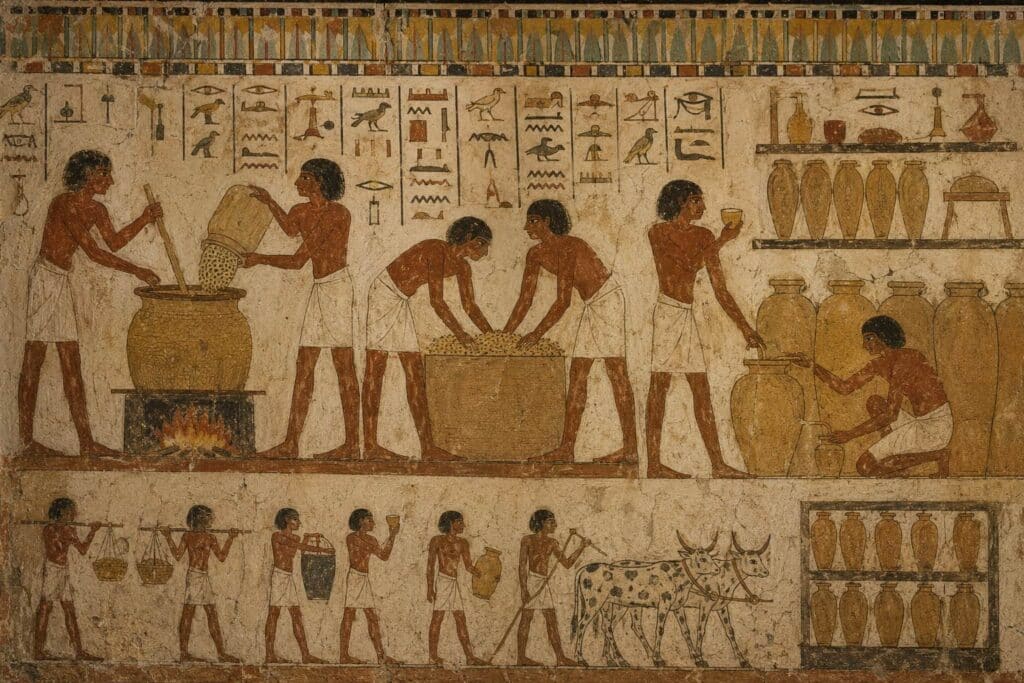
While the Sumerians may have invented it, the Ancient Egyptians perfected the industrial-scale production of beer. In the Nile Valley, beer (known as heqet or tenemu) was a dietary staple essential for survival. Because the Nile’s waters were often contaminated, the fermentation process provided a safer alternative for hydration. For the builders of the pyramids at Giza, beer was a primary form of compensation. Records indicate that laborers were provided with a daily ration of about two gallons of beer, which provided the necessary carbohydrates, B-vitamins, and minerals to sustain intense physical labor under the desert sun.
Egyptian brewing was a sophisticated affair involving specialized bakeries and breweries. They used a variety of grains, though emmer wheat and barley were the most common. Interestingly, Egyptian beer was not just for the living; it was a critical component of funerary offerings. The “False Doors” in tombs often listed beer alongside bread as the most desired items for the deceased in the afterlife. The goddess Hathor, often called the “Mistress of Drunkenness,” was the patroness of beer, and festivals in her honor involved large-scale consumption intended to bring the worshipper closer to the divine through a state of “joyful intoxication.”
Medical papyri from the era also list beer as an ingredient in hundreds of remedies. It was used as a base for herbal medicines, a digestive aid, and even a mild anesthetic. The Egyptian commitment to brewing was so total that they even established state-run breweries to ensure a steady supply for the military and public works projects, making it one of the first truly commercialized products in human history.
Vedic India and the Sacred Sura
In Ancient India, the history of fermented beverages is found within the sacred verses of the Rigveda, composed around 1500 BCE. While later Hindu and Buddhist traditions would move toward asceticism and temperance, the early Vedic period celebrated a beverage called Sura. Unlike Soma, which was a mysterious and possibly hallucinogenic ritual drink reserved for the highest priests, Sura was a grain-based beverage enjoyed by warriors (Kshatriyas) and commoners alike.
Sura was prepared using fermented barley or rice and was often seasoned with various spices and herbs to enhance its flavor and potency. It was associated with the god Indra, the king of the gods and a patron of warriors, who was said to consume vast quantities of the drink to gain strength before battle. The brewing process in India was unique, often utilizing a fermentation starter known as kinva, which consisted of a mixture of grains and medicinal plants. This tradition highlights that while beer history is often viewed through a Western lens, the East had developed its own robust and culturally significant brewing traditions long before the advent of modern international trade.
The Ancient East: China’s Rice and Millet Traditions
Turning to China, the history of beer rivals any other region in antiquity. Archaeological findings at the Jiahu site in Henan province have revealed that Neolithic Chinese populations were brewing a complex fermented beverage as early as 7000 BCE. This “Jiahu cocktail” was a blend of rice, honey, hawthorn fruit, and wild grapes. While it differs from the purely grain-based beers of Mesopotamia, it represents the same human impulse to harness yeast and sugar for social and ritual purposes.
By the time of the Shang Dynasty (c. 1600–1046 BCE), the Chinese had differentiated between several types of fermented grain drinks. There was Li, a sweet, low-alcohol beer made from sprouted grains (malting), and Jiu, a more potent beverage made using the Qu method. The Qu method, which uses mold cultures to break down grain starches into fermentable sugars, was a revolutionary technical advancement that allowed for much higher alcohol content than traditional malting. These beverages were poured into magnificent bronze vessels, such as the Zun and You, and were central to the ancestral worship ceremonies that defined Chinese social structure for centuries. The production of these drinks was a state-regulated affair, with specialized officials overseeing the quality of the “fermentation starters” used in the imperial breweries.
Medieval Europe: From Kitchen to Monastery
As the classical world transitioned into the Middle Ages, the center of brewing shifted to the cooler climates of Northern Europe, where grapes struggled to grow but barley and oats flourished. Initially, brewing was a domestic task, primarily the responsibility of women. These “ale-wives” or “brewsters” produced small batches of ale for their families and sold the surplus to neighbors. A broom hung outside a door was the traditional sign that a fresh batch of ale was available for purchase.
However, the true “professionalization” of beer occurred within the walls of Christian monasteries. During the 9th to 11th centuries, monasteries became the most advanced centers of technology and learning in Europe, and this extended to brewing. Monks found that beer was a nourishing “liquid bread” that could be consumed during Lenten fasts when solid food was forbidden. Because monasteries often hosted travelers and pilgrims, they built massive brewing facilities to provide safe, consistent beverages for their guests. It was during this time that monks began to systematically document their processes, leading to improvements in hygiene and yield.
The most pivotal moment in European beer history was the widespread adoption of hops. Before hops, brewers used gruit—a mixture of herbs and spices like bog myrtle, yarrow, and ginger. Gruit didn’t just provide flavor; it was a source of tax revenue for the local lords or the church who held the “gruitrecht” (the right to sell the herbs). The hop plant (Humulus lupulus) changed the landscape because its acids acted as a powerful natural preservative, allowing beer to be stored for months and shipped over long distances. By the 14th century, the Hanseatic League was shipping hopped beer across the Baltic and North Seas, turning beer into a global commodity.
The Renaissance and the Purity of the Brew
By the 16th century, beer had become such a vital part of the European economy that governments began to intervene to ensure quality. The most famous of these interventions was the Bavarian Reinheitsgebot of 1516. This “Purity Law” decreed that beer could only be made from three ingredients: water, barley, and hops. Yeast was not mentioned because its biological role was not yet understood; brewers simply relied on the “magic” of the air or reused the sediment from previous batches. This law was partially a food safety measure (to prevent the use of toxic or hallucinogenic herbs sometimes found in gruit) and partially an economic one (to ensure that wheat and rye were reserved for bread-making).
The 18th century brought the Industrial Revolution, which transformed beer from a craft into a science. The invention of the steam engine by James Watt allowed for the mechanization of mills and pumps, while the invention of the thermometer and saccharometer gave brewers the ability to measure temperature and sugar content with precision. In London, the development of “Porter”—a dark, aged beer—became the world’s first mass-produced industrial product, brewed in massive vats that could hold thousands of barrels. The British Empire also gave rise to the India Pale Ale (IPA), which was heavily hopped and high in alcohol to survive the long sea voyage to the colonies in India.
Modernity and the Craft Revolution
The 19th and 20th centuries saw the consolidation of the beer industry. The work of Louis Pasteur on yeast and the development of commercial refrigeration by Carl von Linde allowed for the global dominance of light, crisp lagers. For decades, the market was dominated by large, multi- national corporations producing standardized products. However, the late 20th century saw a powerful backlash. The “Craft Beer Movement” began as a grassroots effort to revive forgotten styles and prioritize flavor over efficiency.
Today, the beer world is more diverse than ever. We see a return to ancient methods, such as barrel-aging and wild fermentation, combined with cutting-edge science. From the traditional pubs of London and the beer halls of Munich to the emerging taprooms of the Baltics, the culture of beer is a thriving, living history.
In the modern era, the appreciation for this history is reflected in the curation of fine beverages across the globe. For instance, the growing interest in Beer in Tallinn showcases how historical European styles are being embraced and reimagined by a new generation of enthusiasts. Finding the perfect pint has never been easier, as a dedicated Beer shop today offers a variety that would have been unimaginable to a medieval monk or an Egyptian laborer. The extensive and carefully curated Beer collection in Estonia, notably at places like Heldeke bottle shop, allows drinkers to taste the culmination of ten thousand years of brewing evolution, proving that while techniques change, the human love for a well-crafted beer remains eternal.
Selected References and Further Reading
- McGovern, Patrick E. (2009). Uncorking the Past: The Quest for Wine, Beer, and Other Alcoholic Beverages. University of California Press. (An essential text on the bio-archaeology of ancient drinks).
- Standage, Tom. (2005). A History of the World in 6 Glasses. Walker & Company. (Discusses how beer, wine, and spirits shaped human civilization).
- Hornsey, Ian S. (2003). A History of Beer and Brewing. Royal Society of Chemistry. (A technical and historical overview of brewing evolution).
- Nelson, Max. (2005). The Barbarian’s Beverage: A History of Beer in Ancient Europe. Routledge. (Focuses on the transition from the ancient world to the medieval era).
- Ungar, Richard W. (2004). Beer in the Middle Ages and the Renaissance. University of Pennsylvania Press. (The definitive work on the rise of the commercial beer industry in Europe).
- Wang, J., et al. (2016). “Revealing a 5,000-y-old beer recipe in China.” Proceedings of the National Academy of Sciences. (Detailed archaeological study of early Chinese fermentation).


