
Whiskey is more than just a spirit; it is a liquid chronicle of European history, a testament to monastic ingenuity, and a survivor of centuries of political turmoil. While many today associate the drink with the rugged landscapes of Kentucky, the true soul of whiskey, or uisge beatha (the water of life), was forged in the mist-covered valleys of Ireland and Scotland.
To understand whiskey is to understand a thousand-year evolution from medicinal alchemy to a global symbol of refined craftsmanship.
The Alchemical Roots (1000 – 1400 AD)
The art of distillation did not begin with alcohol, but with perfume. Ancient Mesopotamians were refining aromatics as early as 2000 BC, but it wasn’t until the early medieval period that traveling monks brought this knowledge from mainland Europe into the British Isles.
In the sun-drenched monasteries of Italy and France, monks distilled wine. However, as the practice migrated north to Ireland and Scotland, the lack of vineyards forced a creative pivot. Instead of grapes, the monks turned to what they had in abundance: fermented grain mash. This adaptation birthed the first true whiskeys. By 1405, the Irish Annals of Clonmacnoise recorded the first written mention of “whisky,” tragically noting a clan head who died after “taking a surfeit of aqua vitae.”
The Royal Blessing and the Great Dissolution
Whiskey’s status shifted from a monastic medicine to a social staple in 1494, when the Scottish Exchequer Rolls recorded King James IV ordering “eight bolls of malt” to produce aqua vitae.
However, the industry’s biggest catalyst was a political one. In 1541, King Henry VIII dissolved the monasteries across England and Ireland. Suddenly, a legion of monks was left without a home but with a very specific set of skills. They took their distillation secrets to the general public, turning a monastic secret into a cottage industry.
The Era of Smugglers and Moonshine (1700s)
The 18th century was a period of rebellion for whiskey. Following the Acts of Union in 1707, which joined England and Scotland, taxes on malt and spirits skyrocketed to fund the British Empire’s wars.
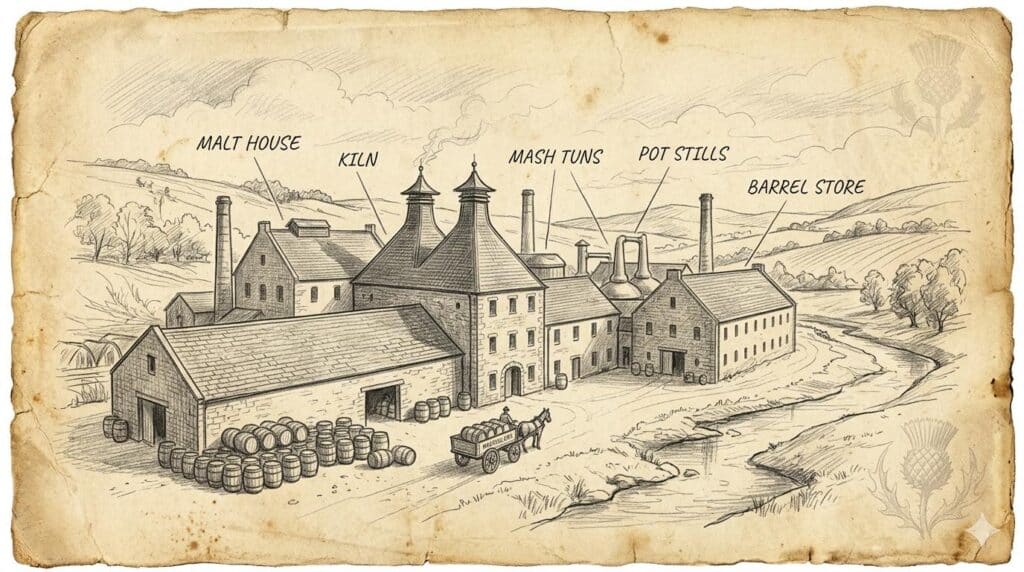
This led to a legendary era of “moonshining.” Scottish distillers moved their operations underground, distilling at night to hide the smoke from tax collectors (the “Gaugers”). This clandestine culture refined the spirit; the necessity of hiding barrels in damp caves and cellars accidentally improved the aging process, lending whiskey the complex, woody notes we celebrate today.
The Industrial Revolution: The Coffey Still
For centuries, whiskey was made in batches using copper pot stills. This changed in 1831 when an Irish inventor named Aeneas Coffey patented the “continuous still.” This innovation allowed for a much higher alcohol content and a faster, more efficient production process. While some traditionalists in Ireland initially scoffed at it, the Coffey still allowed Scotch whiskey to scale globally, providing the lighter grain whiskies needed for the famous blends that conquered the world.
Modern Masterpieces: A Curated Selection
Today, the European whiskey scene—led by Scotland and Ireland—continues to push boundaries, blending ancient tradition with modern culinary science. If you are looking to explore the pinnacle of current offerings, these selections from the Heldeke! Bottle Shop represent the gold standard of the craft.
1. Johnnie Walker Blue Label: Elusive Umami
This limited edition is a masterclass in blending. Inspired by the Japanese concept of the “fifth taste,” it moves beyond the traditional profiles of sweet or smoky. It begins with a honeyed sweetness, transitions through dried fruits, and finishes with a sensational, savory umami note that lingers on the palate. It is a sleek, vibrant experience designed for the modern connoisseur.
2. Ardbeg Y2K 23-Year-Old
For those who love the peat-smoke intensity of Islay, the Ardbeg Y2K is a monumental bottle. Having aged for over two decades, it captures the raw, maritime energy of the Scottish coast, softened by years of patient maturation in the barrel.
3. North Star Glendronach 31-Year-Old (1991 – 2022)
Representing the heights of luxury, this single malt is a relic of the early 90s. Aged for 31 years, it offers the deep, sherry-driven complexity that Glendronach is famous for—dark chocolate, heavy oak, and rich spice.
4. Macallan 15-Year-Old Double Cask
The Macallan remains the “Rolls Royce” of Scotch. The Double Cask range uses a harmonious balance of European and American oak (both sherry-seasoned), resulting in a warm, honeyed spirit with notes of ginger and butterscotch.
5. Bruichladdich Octomore 13.1
If you want to understand the “smoky” side of whiskey history, there is no better teacher than Octomore. Known as the world’s most heavily peated whiskey, it is a bold, experimental dram that proves European distillers are still the world’s greatest innovators.
The Legacy Continues
From the oldest licensed distillery in the world, Old Bushmills in Northern Ireland (licensed in 1608), to the experimental umami blends of today, whiskey remains a bridge between the past and the present. Whether you prefer a light Speyside malt or a heavy Islay smoke, every glass is a sip of a thousand-year European journey.


