


Triinu Upkin is one of the most distinctive creative voices in Estonia’s performing arts landscape. Blending her work as an Estonian National Ballet dancer, vocalist, songwriter, choreographer, and dance semiotician, she stands as Estonia’s, and potentially the world’s, only singing ballerina.
I sat with her and had a chat about the music industry, independent artists, and the Fringe festival.
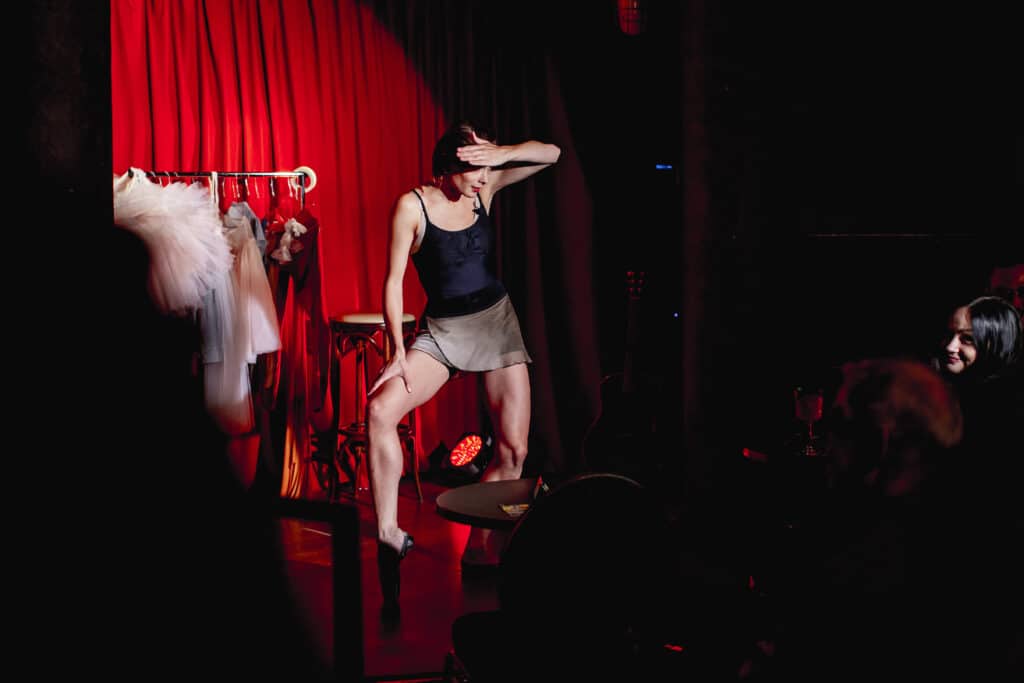
Arashk Azizi: How does taking the stage at a major opera house compare to performing in an intimate indie venue, and how does that close distance shift your connection with the audience?
Triinu Upkin: Being just feet away from an audience requires a huge amount of focus. Having done over 1,000 shows on the National Ballet’s grand stage, stepping into smaller, intimate settings felt both exhilarating and nerve-wracking, yet immensely rewarding and freeing. In a major production, your responsibility is higher in terms of scale, audience size, and team commitments. But because that weight is distributed among many, it also feels lighter—partners cover mistakes, no single person is irreplaceable, and the show goes on. When I produce my own work, I own everything. There is no large cast to hide behind. That lets me express my true self and step into any role I choose, but I have to maintain the standard to carry the performance. Close audience interaction is brutally honest!
Arashk: Having taken part in Fringe multiple times, what does the festival mean to you personally?
Triinu: To me, Fringe represents total artistic liberation. Bridging dance, vocals, songwriting, and staging puts my work in a category that is hard to define—is it a concert, a dance show, a musical, stand-up, or an artistic event? Fringe removes those labels entirely; it is completely acceptable for my performance to be all of those elements combined into a “Triinu show” without needing further justification.
Arashk: What stands out as your most unforgettable or unexpected Fringe moment, on stage or off?
Triinu: Packed houses! Alongside the genuine warmth and solidarity among fellow performers.
Arashk: Moving from a national ballet company with built-in production and PR teams, what was the hardest lesson in managing everything yourself?
Triinu: Stepping out as a musician prior to this gave me an initial taste of self-promotion, so I wasn’t diving in completely unprepared. But taking full control of your own projects forces you to mature quickly. The hardest hurdle was overcoming classic modesty—if you don’t talk about your work and showcase what you do, no one will know your show exists and no one will buy tickets.
Arashk: How do you manage the heavy physical stress of dancing alongside the continuous grind of flyering, marketing, and ticket sales?
Triinu: Fortunately, years of elite training have made me resilient and physically strong, so I don’t give in to self-pity. I handle whatever needs doing, and my fitness allows me to give 100% on stage every night. Honestly, I mostly need someone around to remind me when to take a break!
Arashk: Has a performance or promotional effort at Fringe ever turned out differently than expected, and what did it teach you?
Triinu: I approach Fringe with open curiosity, so nothing has felt like a major setback. The biggest lessons have been personal, discovering how adaptable I am in unfamiliar settings, and realizing how much I can rely on my foundational training when taking creative risks.
Arashk: Who would you recommend the Fringe experience to, as a performer or spectator?
Triinu: Anyone driven by curiosity, on stage or in the crowd.
Arashk: What would you tell classically trained artists who have creative ideas but are afraid of the DIY Fringe environment?
Triinu: I’d tell them to take the leap. What is the absolute worst outcome, eternal embarrassment? Haha, joking aside! Putting your own work out there leaves any artist exposed. But if you never take the risk, nothing happens. Fringe is actually one of the safest platforms to test wild concepts because the festival environment acts as a supportive cushion.
Arashk: Complete this sentence: “An artist should perform at Fringe at least once because…”
Triinu: It is an uncompromising mirror showing your true current level as an artist.
This interview was originally published on the Tallinn Fringe Festival website.


