


The history of wine is inextricably linked with the rise of great human civilizations. But while ancient Mesopotamia, Egypt, and Greece integrated the fermented grape into their economies and state religions, it was medieval Persia that transformed wine into the ultimate literary monument. Following the Islamic conquest of Persia, a fascinating paradox emerged: a culture whose official religion strictly forbade the consumption of alcohol became the world capital of wine literature.
To understand how this happened, we have to look past the religious laws on paper and look at the bustling, tangible reality of the medieval Persian wine business.
Iran in the Islamic Era: The Thriving Underground Wine Trade
When Islam became the dominant faith in Iran, wine did not vanish. Instead, the wine trade adjusted to a unique socio-economic landscape. Islamic law prohibited Muslims from producing, selling, or drinking alcohol, but it granted religious freedom and autonomy to minority communities living within the empire, namely Zoroastrians, Christians, and Jews.
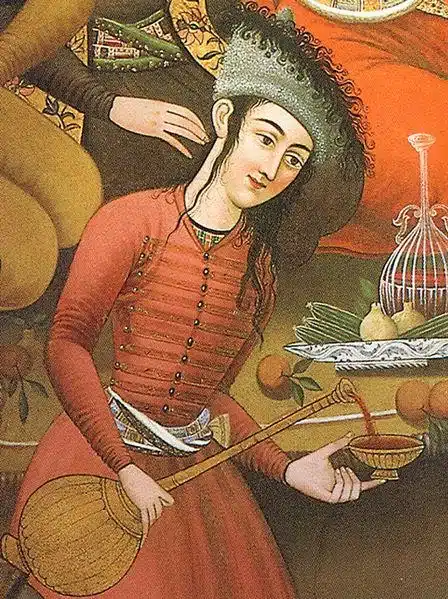
These communities became the licensed vintners of Persia. They cultivated expansive vineyards in regions famous for their ideal terroir, such as the hillsides of Shiraz, Nishapur, and Hamadan.
The wine trade operated as a highly organized, semi-underground economy:
- The Taverns (Kharabat): Usually located in minority quarters or at caravan stops just outside city walls, these physical establishments were lively hubs of social convergence.
- The Bureaucracy: Local governors and rulers were fully aware of these operations. Instead of shutting them down, they levied heavy secular taxes on the production and transport of clay wine jars (khom). The revenue was so massive that the ruling class routinely looked the other way.
- Daily Integration: Wine was used medicinally, served at private court banquets of the ruling elite, and enjoyed by everyday citizens looking for an escape. It was an omnipresent, highly visible part of urban and rural life.
Poets and Wine: Reality Behind the Metaphor
Open any anthology of classical Persian poetry, whether by Ferdowsi, Khayyam, Rumi, or Hafez, and you will find the pages drenched in wine. Modern literary critics often explain these endless references as pure spiritual metaphors. In Sufi mysticism, for instance, wine represents divine love, the tavern is the spiritual heart, and intoxication is the ecstasy of losing oneself in God.
However, this argument overlooks a fundamental rule of human language: metaphors must be based on tangible, everyday realities.
You cannot use something completely unknown, invisible, or unfamiliar to explain a complex concept to an audience. For a metaphor to work, one side of the equation must be deeply familiar to everyone. The fact that Persian poets constantly used wine to communicate their deepest ideas, whether epic, philosophical, or mystical, proves that their contemporary audience was intimately acquainted with the drink, its aroma, its taste, and its physical effects.
When Ferdowsi invokes wine in the Shahnameh to celebrate kingly glory, or when Rumi uses it to describe spiritual rapture, they are leaning on a shared cultural familiarity with the actual beverage.
Nowhere is this fluid line between reality and metaphor clearer than in the verses of Omar Khayyam and Hafez. For both poets, wine exists simultaneously as a tangible, physical comfort and a profound symbolic rebellion.
Omar Khayyam: The Physical Cure for Existential Dread
The 11th-century polymath Omar Khayyam was an astronomer and mathematician who calculated the solar calendar. His relationship with wine was deeply grounded in the physical reality of human exhaustion and mortality:
من بی می ناب زیستن نتوانم
بی باده کشید بار تن نتوانم
من بنده آن دمم که ساقی گوید
یک جام دگر بگیر و من نتوانمWithout pure wine, I cannot live,
Without the cup, the body’s weight I cannot bear.
I am the servant of that breath when the cupbearer says,
“Have one more cup,” and I no longer can.
Is this metaphorical? Perhaps. But it is also intensely physical. Khayyam speaks of the literal physical toll of life—the “body’s weight” (bar-e tan). To him, a real glass of “pure wine” was a tangible substance that slowed down time, relieved the physical weight of existence, and anchored a tired human being into the immediate present.
Hafez: The Bold Punch of Reality
Centuries later in Shiraz, Hafez wrote verses where the physical characteristics of real, local wine were explicitly demanded to cope with a chaotic world:
شرابِ تلخ میخواهم که مردافکن بُوَد زورش
که تا یک دَم بیاسایم ز دنیا و شر و شورشI want a bitter wine, whose strength knocks a man down,
So that for a single moment, I can rest from the world and its chaotic noise.
Hafez specifically asks for sharab-e talkh—bitter wine. Historically, medieval Persian winemakers aged their vintages in sealed clay pots, often resulting in a high-tannin, bold, and distinctly bitter profile. He also notes its physical potency (mardafoor—strength that knocks a man down). While this verse carries massive metaphorical weight regarding political and social defiance, it relies entirely on the reader knowing exactly what a heavy, bitter, strong cup of real Shiraz wine feels like when it hits the system.
Final Thoughts: An Otherworldly Legacy
Wine has been a brilliant source of inspiration for artists around the globe across millennia. We see it carved into the stone reliefs of ancient Mesopotamia, painted on the tomb walls of Egyptian pharaohs, and praised in the theatrical drinking songs of ancient Greece right up to modern Western literature.
Yet, the poetry of the Persians surrounding this drink is entirely otherworldly. Nowhere else in human history did a forbidden substance produce such a vast, sophisticated, and beautifully sustained body of masterpieces. The scale, depth, and lyrical beauty of Persian wine poetry are unmatched in global literature.
This poetic world is so powerful that it completely transcended cultural and linguistic borders centuries later. The legendary German writer and polymath Johann Wolfgang von Goethe became so utterly captivated by the verses of Hafez that he famously learned Persian (Farsi) later in his life.
Goethe wanted to experience these masterpieces in their true, original rhythm, free from the constraints of translation. His encounter with Persian poetry inspired his own masterwork, the West-östlicher Divan (West-Eastern Divan), proving that the liquid verses born in the forbidden taverns of medieval Iran ultimately poured out to intoxicate the literary mind of the entire world.


